"The purchasers of this land will engage in the growing of citrus fruits." That was the stated hope of Seymour Jordan, Robert Grace and Charles Keafer, the developers behind the original Arcadia plat recorded in December 1919, according to the Arcadia Camelback Mountain Neighborhood Association's history of the area. They divided the land east of 56th Street into lots of roughly ten acres and the land west of it into lots of roughly five, and the association's history says those lots were designed to be sold as small citrus orchards.
A century later the orchards are backyards. The trees still keep the schedule they were planted for, and that schedule was built around Thanksgiving.
The Holiday Market Arcadia Was Planted For
Arcadia's citrus history starts before the subdivision does. Arcadia News traces the Salt River Valley's first citrus acreage to W.J. Murphy, who planted it in 1899 near 56th Street and Indian School Road, next to the Arizona Falls. Murphy tried many crops across the Valley and found that citrus did especially well in the soil south of Camelback Mountain.
The timing is what made the business work. The same Arcadia News history says that in the early 1900s Arizona growers could harvest navel oranges as early as November, while California growers could not get their boxcars to the Chicago Mercantile Exchange by mid-November. Demand for citrus peaked around Thanksgiving, so Arizona fruit arrived early and claimed a large share of the market.
The first tract recorded in today's Arcadia was not the Arcadia subdivision. It was Citrus Homes, recorded by L.E. Froman in June 1915. Its 25 lots were bounded by Camelback Road and Lafayette Boulevard on the north, 56th Street on the east and the Arizona Canal on the south. Water shaped the rest of the district, a story we told in our look at Arcadia's flood irrigation rights. The Arcadia Water Company formed in 1919, and by 1924 crews had laid fifteen miles of underground concrete pipe to carry water to the groves.
Today is Thanksgiving, and much of the fruit in Arcadia's backyards is ripening right on that old schedule. The trouble is that the neighborhood's donation calendar runs on a different one.
What Ripens Between Now and May
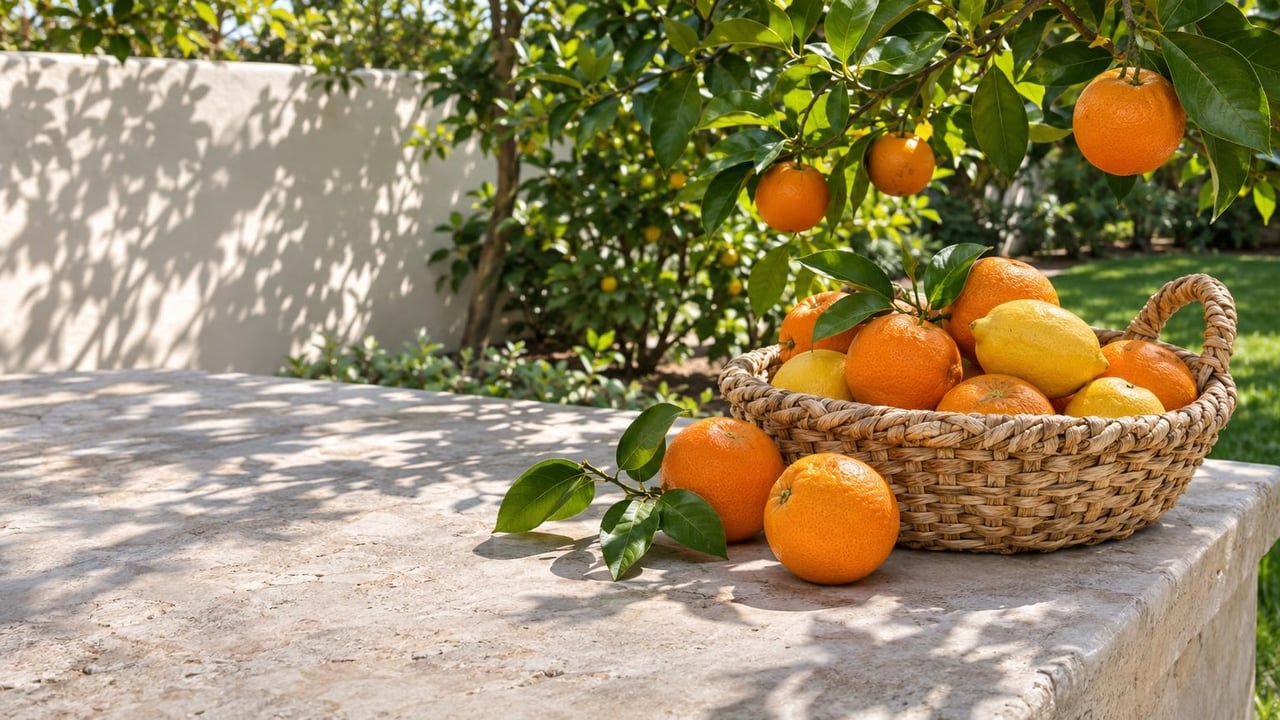
University of Arizona Cooperative Extension says there is always a sweet orange variety ready to eat in Arizona from late October through late May. The navel in most Arcadia yards is likely the Parent Washington. Extension calls it the most popular navel grown in Arizona and says virtually all of the old navel orchards still standing in Central Arizona are Washingtons. Its fruit is ready to harvest beginning in early December and lasts through March.
Extension's low-desert variety guide dates to 1998, but its harvest windows are still a useful regional baseline for the other common backyard trees.
| Variety | When Extension says it's ready |
|---|---|
| Algerian, also sold as Clementine, mandarin | Ripens in November |
| Fairchild mandarin | Ripens in November, about the same time as Algerian |
| Parent Washington navel orange | Early December through March |
| Dancy mandarin | Harvested beginning in December |
| Kinnow mandarin | Matures in January |
| Marsh white grapefruit | Ready to harvest in December, typically best March through May |
Two notes from Extension affect every date in that table. Citrus does not ripen once it is picked, but fruit left on the tree keeps getting sweeter as the season goes on. Extension also says to judge an orange by tasting it rather than by its peel, because early oranges are often sweet before their skins fully color. Marsh, which Extension calls the most widely planted white grapefruit in the Salt River Valley, is the clearest case for patience. It can be picked in December, but it is usually at its best in spring once its acid has dropped.
Lemons run on their own schedule. One Valley nursery says the Improved Meyer carries fruit for much of the year, with its heaviest crop in winter, and should be picked once it turns golden yellow.
So a typical Arcadia yard has mandarins ready now, navels starting next week and a grapefruit tree that improves the longer it waits.
The Donation Calendar Starts in January
St. Mary's Food Bank runs the Valley's best-known citrus program. Its page, posted Sept. 15, 2026, shows a season that begins well after Arcadia's first fruit ripens. Drop-offs from every ZIP code open January 11, 2027, and run through April 30, 2027, at the Phoenix warehouse at 2831 N. 31st Avenue from 8 a.m. to 4 p.m. and at the Surprise site at 13050 W. Elm Street from 8 a.m. to 3 p.m.
St. Mary's free volunteer picking service is limited to four West Valley ZIP codes: 85351, 85373, 85374 and 85375. Registration for those ZIP codes closes Monday, November 30, 2026. Arcadia's 85018 is not on that list. Even inside those ZIP codes, the food bank says it expects a very limited volunteer crew, warns that registering does not guarantee a pick and suggests homeowners line up another option in advance.
To make up for fewer volunteers, St. Mary's is partnering with two churches to host Citrus Saturday drop-offs. One is in Arcadia. Food bank staff and trucks will collect fruit at Shepherd of the Hills UCC, 5524 E. Lafayette Blvd., on Saturdays, February 6, 13 and 20, 2027, from 9 a.m. to 3 p.m. That address is on Lafayette Boulevard just west of 56th Street, the two streets that formed the north and east edges of the 1915 Citrus Homes plat.
The food bank asks for clean fruit with no leaves, stems, decay or debris. Questions go to [email protected] or (602) 343-5658.
A late-winter collection is an Arcadia habit. A past Arcadia News report on donating leftover citrus described gleaning between January and March as a familiar event for Arcadia residents. The same report traced it to the Arcadia Citrus Program, a volunteer group formed after roof rats were discovered in 2001 that collected fruit from the surrounding neighborhoods. That program was suspended in 2015 after the Asian citrus psyllid was found in western Maricopa County. Since then, the report said, residents have donated fruit themselves or hired someone to pick and haul it away.
That leaves a gap. Mandarins ripen in November and navels in early December, but Arcadia's own collection doesn't open until the first Saturday in February.
Sorting the Trees by Where Their Fruit Can Go
Each tree's harvest window points to a different outlet.
Grapefruit is the easiest. Marsh fruit picked in December is edible but still tart, and Extension says it keeps sweetening on the tree into spring. A grapefruit tree can wait for the Shepherd of the Hills Saturdays in February. By then the fruit is closer to its best, and the drop-off is on Lafayette Boulevard inside the neighborhood.
Navels give the most room. A Parent Washington crop that starts in early December still holds through March, so one tree can feed the Thanksgiving-to-New Year's table and still have fruit left for the St. Mary's drop-off window that opens January 11 or for the February Saturdays.
The early mandarins, Algerian and Fairchild, have the least room. They ripen in November, months before either St. Mary's option opens. For a December harvest, Homegrown is one Valley option. The nonprofit asks homeowners to fill out a form with what's ripe, roughly how much there is, whether it's already picked, when it will be ready and which city it's in. Its crew and volunteers then pick on the homeowner's schedule. Homegrown says it brings the ladders, pickers and boxes at no cost, though a removal fee may apply to very large jobs, and it will say so first. It shares and sells the fruit in the Valley and sends what doesn't sell to food banks and neighbors. Its form lists oranges, lemons, grapefruit, tangerines and limes, so a full December harvest of mixed fruit has one place to go. Its site does not publish pickup dates, so the timing is set when its crew texts back.
Lemons fit around everything else. An Improved Meyer that bears much of the year, with its heaviest crop in winter, can split its fruit between a December pickup and the February drop-offs.
Laid out by month, the season looks like this for an Arcadia yard:
- Late November: taste the Algerian and Fairchild mandarins, and send any surplus through Homegrown's form.
- Early December: the Parent Washington navels begin, and the Dancy mandarins start soon after.
- January 11: St. Mary's drop-off opens at 2831 N. 31st Avenue for every ZIP code, and Kinnow mandarins mature.
- February 6, 13 and 20: Citrus Saturdays at Shepherd of the Hills UCC, 5524 E. Lafayette Blvd., 9 a.m. to 3 p.m.
- March through May: Marsh grapefruit reaches its best, and the St. Mary's drop-off runs through April 30.
The groves along 56th Street were planted to get fruit to Chicago by Thanksgiving. This winter, the same trees can send fruit to a church on Lafayette Boulevard in February 2027, as long as each one is picked in its own month.
If you're thinking about how a mature citrus yard fits into your own plans for an Arcadia property, The Avenue Collective can walk the grounds with you and talk through what those trees add to the home. Schedule a white-glove consultation, and see more of the neighborhood on our Arcadia page.